
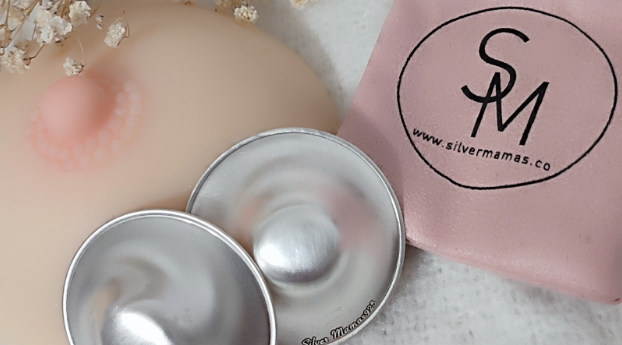
Before going on to explain what they are for and what the mechanism of action of silver discs is, it is important to clarify that there is only one pilot study developed on this topic, with the use of a specific brand, in which improvement was reported between 7 and 15 days (Marrazzu et al., 2015).
A systematic review of the Cochrane literature concluded that, regardless of the treatment used, for most women, nipple pain was reduced to mild levels approximately 7 to 10 days after delivery (Dennis et al., 2014). However, this study did not include the article described above.
Before proceeding with any treatment or purchasing another device proposed to improve nipple pain, it may be important to assess your baby’s positioning and grip. To do so, I recommend that you consult this post of ours:
5 steps to an effective and pain-free grip
If you consider it pertinent, you can also contact us so that we can accompany you in this process, which is sensitive but transient. I leave you with this certainty.
Having done this framework, let’s talk about what silver discs are and why they are so recommended. On a personal level, I can say that I used them and had a very positive experience. However, itwould be incorrect to say that the result I obtained can be extrapolated to all women. The available scientific evidence is still limited and leaves many questions unanswered; for this reason, I choose to share with you only the knowledge we have so far about silver discs, so that you can make your own decision.
The Natural Solution for Breastfeeding Comfort
Breastfeeding is a time of deep bonding, but cracks and nipple pain can make it a real challenge. For those looking for a natural option, silver discs often appear as a possible solution.
Silver is a metal that has been used for centuries for its antibacterial and anti-inflammatory properties. More recently, these properties have been applied in the development of discs designed to be placed directly on the nipple between feedings. Their use promotes a moist environment, often associated with skin healing, and is presented as a way to aid tissue regeneration and prevent infections such as breast candidiasis.
This approach is often preferred to topical creams, as it does not require washing the breast before breastfeeding, does not alter the taste of the milk and is generally considered safe for the baby.
How to Use and Ensure Maximum Effectiveness
Using the silver discs is simple. After each feeding, and without the need to apply any cream or lotion, a drop of breast milk is placed inside the silver disc, which is then placed directly on the nipple. The nursing bra or top helps to keep the disc in the proper position. - I advise placing absorbent discs between the silver disc and the nursing bra or top, in order to absorb any milk that may leak out.
To ensure their conservation, the necessary cleaning is minimal: daily washing with water and neutral soap is recommended, ensuring that they are well dried after cleaning. With this care, a pair of discs can be used over several weeks or even in different periods of breastfeeding, often being seen as a practical support for maternal comfort.
MaterClinic’s Specialized Support
While silver discs can be a useful tool, pain during breastfeeding is often a sign that the baby’s grip may not be adequate. At MaterClinic, we provide Postpartum Breastfeeding Consultation and Home Support, with a follow-up focused on understanding the individual situation of each family.
Our goal is to give you clarity and autonomy to make informed decisions, helping to identify and correct the causes of cracks and pain in breastfeeding, in order to prevent them from perpetuating over time.
We share with you the references used and wish you a peaceful motherhood.
Scientific Reference
Marrazzu, A., Sanna, MG, Dessole, F., Capobianco, G., Piga, MD, & Dessole, S. (2015). Evaluation of the effectiveness of a silver-impregnated medical cap for topical treatment of nipple fissures in breastfeeding mothers. Breastfeeding Medicine, 10(5), 232-238. Accessed on February 8, 2026. https://doi.org/10.1089/bfm.2014.0177
Dennis, C.-L., Jackson, K., & Watson, J. (2014). Interventions for the treatment of painful nipples in breastfeeding women. Cochrane Database of Systematic Reviews, 2014(12), Article CD007366. https://doi.org/10.1002/14651858.CD007366.pub2